All projects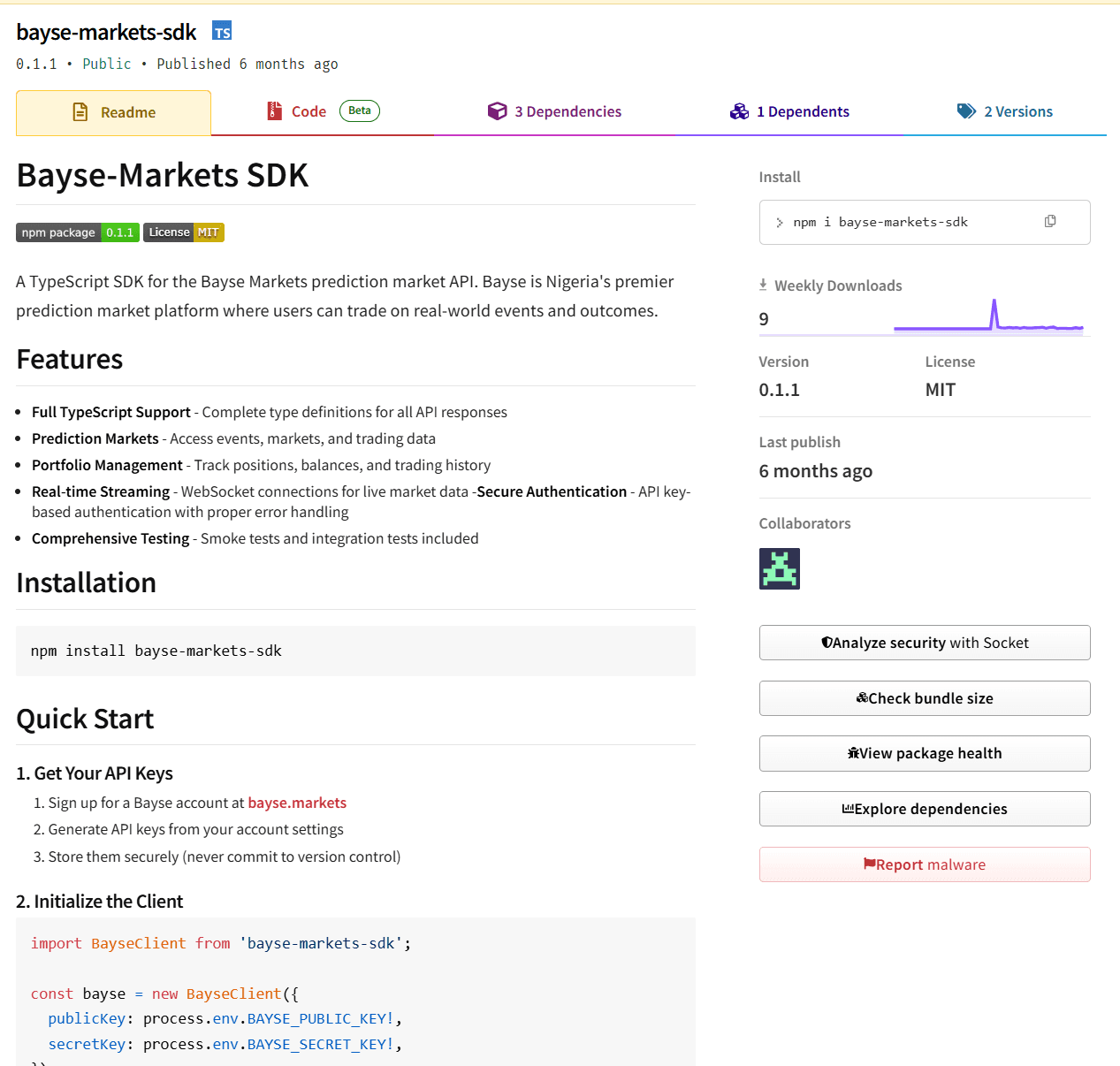
ShippedSolo Builder · 2026
Bayse Markets SDK
Published TypeScript SDK on npm providing typed programmatic access, automated order execution, and live WebSocket streaming for prediction markets.
TypeScriptNode.jsnpmWebSocket
“Prediction markets are only as powerful as their developer tooling — an ergonomic, typed SDK turns raw endpoints into an active trading ecosystem.”
Case Study
01
The Problem
Developers and algorithmic traders building on emerging prediction market platforms frequently struggle with raw, evolving REST and WebSocket APIs. Without typed client libraries, developers must manually construct payloads, manage authentication headers, handle subtle network reconnects, and parse undocumented responses—drastically slowing down bot development, market integrations, and widget embedding.
02
The Insight
A prediction platform's ecosystem thrives when external builders can get from `npm install` to placing their first programmatic trade in under two minutes. By wrapping market discovery, automated AMM order placement, CLOB execution, and real-time WebSocket feeds into a cohesive, fully-typed TypeScript library, I could eliminate the integration friction entirely.
03
The Approach
I designed `bayse-markets-sdk` with developer ergonomics and zero runtime bloat in mind. It needed strict end-to-end type safety, dual ESM/CommonJS distribution, structured error classes for predictable exception handling, and an automated WebSocket manager that transparently reconnects and streams real-time market ticks and FX rates.
04
The Build
I built and published `bayse-markets-sdk` on npm. It provides complete type definitions for markets, orders, quotes, and balances; automated order routing supporting both instant AMM fills and Central Limit Order Book (CLOB) actions; portfolio and wallet balance tracking; and live WebSocket streaming for real-time market updates and crypto/FX price rates (USD/NGN, BTC, ETH, SOL).
05
Technical Decisions
I implemented strict TypeScript 5.4+ with dual compilation outputs (ESM and CJS) via `tsc` to ensure compatibility with Node.js servers, edge workers, and modern bundlers. I created custom typed error classes (`BayseAuthError`, `BayseRateLimitError`, `BayseNotFoundError`, `BayseApiError`) so consuming applications can handle network or validation failures gracefully. The WebSocket layer was built using the native `ws` client with custom ping/pong heartbeats to prevent ghost disconnections.
06
Challenges
Ensuring seamless real-time WebSocket event dispatching without memory leaks or race conditions during rapid market tick bursts required disciplined event listener management. Another challenge was maintaining strict backward compatibility across public beta API adjustments while keeping the SDK surface clean and intuitive for downstream consumers.
07
Outcome
The SDK is published and live on npm (`bayse-markets-sdk`), powering the official `bayse-embed` widget library and serving as the primary programmatic gateway for external developers and trading bots to interact with Bayse Markets.
08
Reflection
In future versions, I plan to introduce built-in automatic rate-limit queuing and configurable exponential backoff strategies directly within the HTTP transport layer, providing even greater resilience for high-frequency trading clients.
Screenshots